On 26 August 2026, Neo Analog Lab signed a retailer agreement with Vintage Visual OÜ of Estonia. We are now an authorised Japanese retailer for the AGO Film Processor and the rest of the AGO ecosystem, serving customers in Japan.
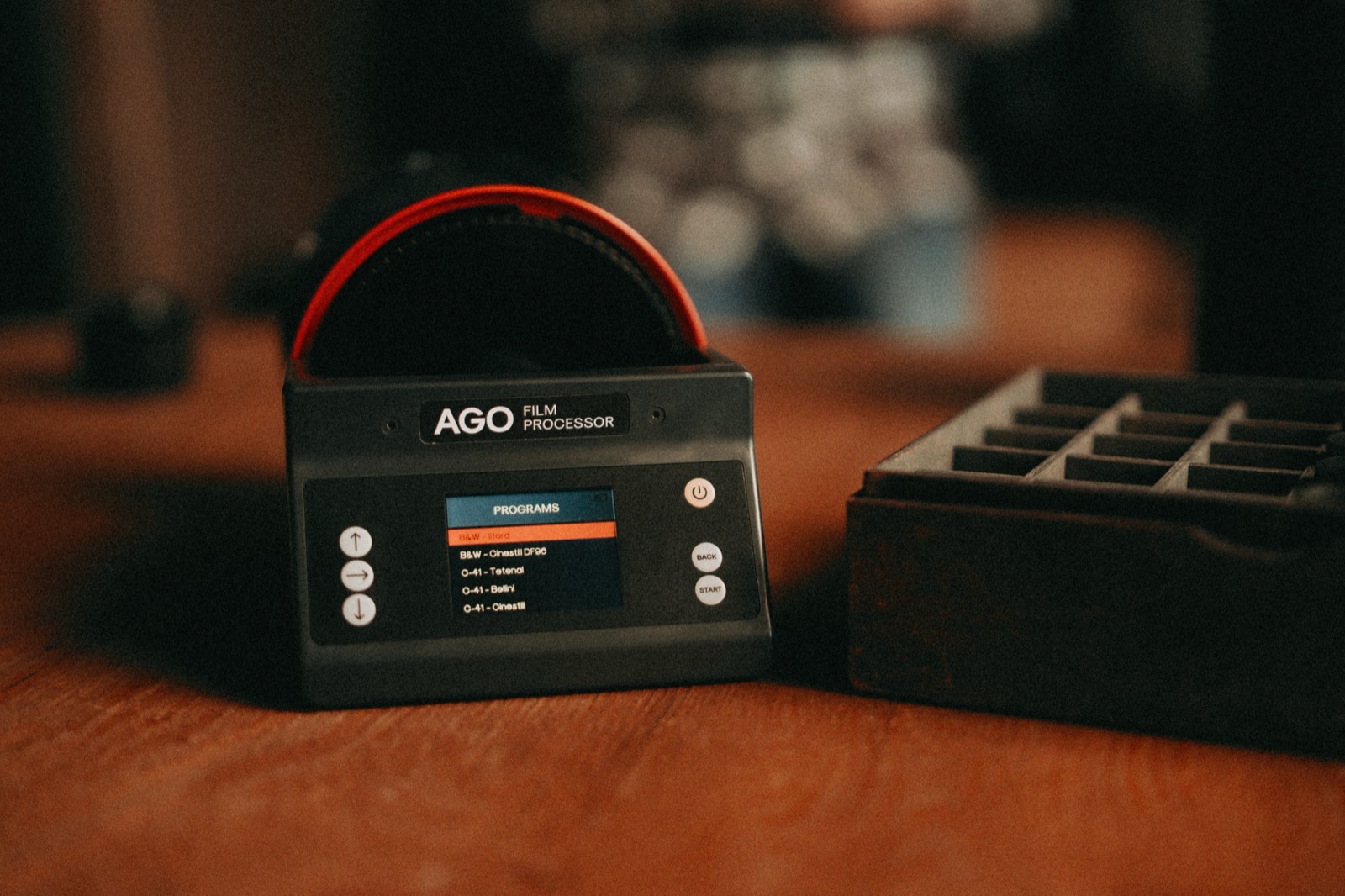
It corrects time instead of chasing temperature
Almost everything that makes colour home development hard comes down to temperature. C-41 wants 38°C. E-6 is stricter still. You sit a bath of chemistry in warm water, watch a thermometer, and add seconds to compensate for every degree it drifts — in a dark room, after the developer is already in the tank.
The AGO Film Processor inverts that relationship. Rather than holding the chemistry at a fixed temperature, it monitors the temperature during processing and automatically adjusts development time to match — Active Time-Compensation. What is left for you to do is warm the chemistry roughly, pick a program, and press start.
Dropping the heater is also why the machine is so small. The battery runs 4–5 hours continuously and charges over USB-C. It works on a kitchen counter, next to a bathroom sink, or wherever you happen to be.
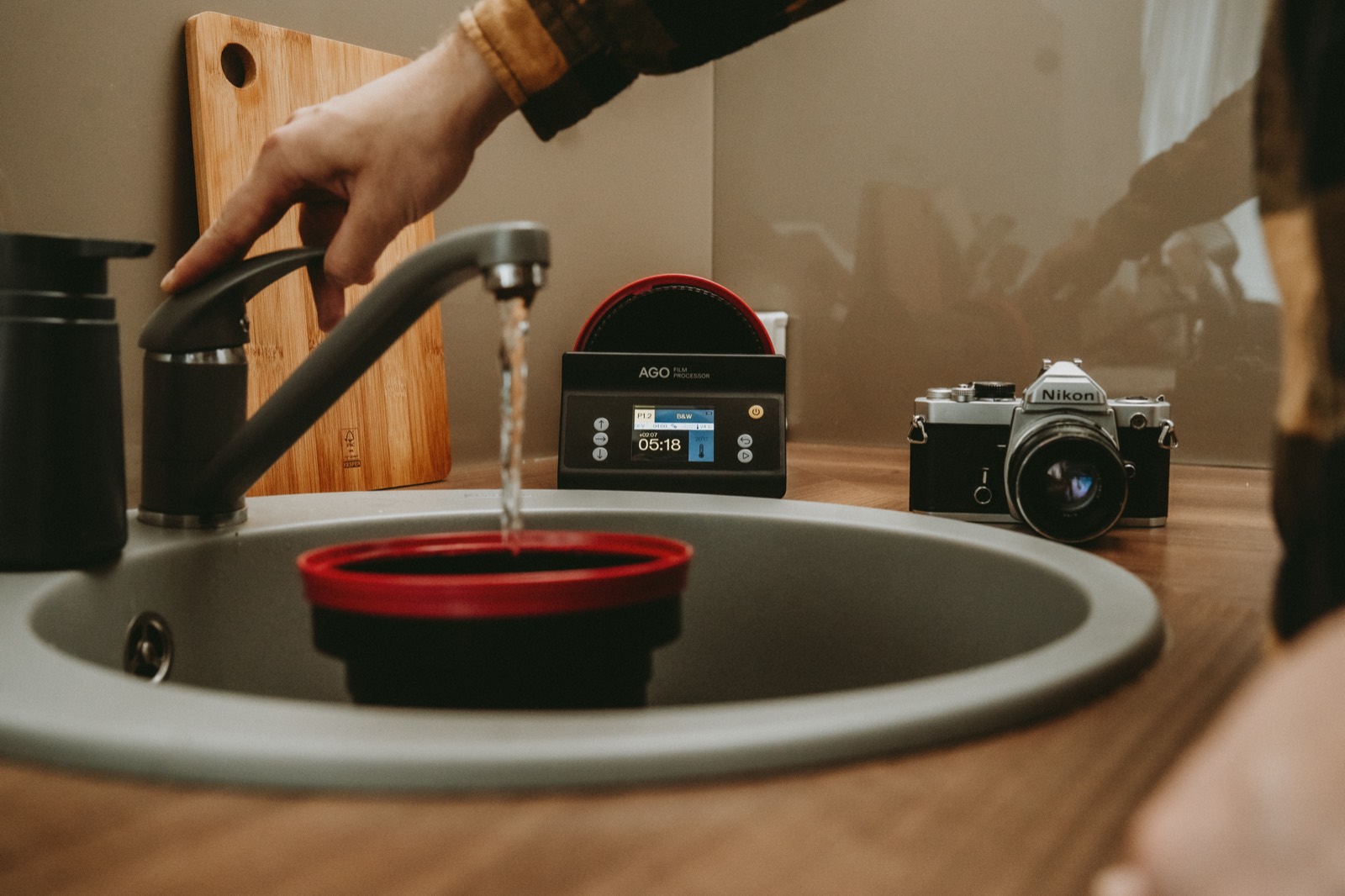
Your Paterson tank becomes an automatic processor
AGO has no proprietary tank. It grips the Paterson Super System 4 tanks already sitting in darkrooms everywhere and turns them.
- Rotary — the tank lies down and rolls. Hands off from start to finish.
- Stick — the centre spindle turns, the way you would agitate by hand. Useful for chemistry that dislikes continuous agitation.
One thing worth knowing: time compensation only runs in rotary mode. Stood upright, the temperature probe does not sit in the liquid, so AGO switches compensation off for stick agitation. If you want the machine to handle temperature for you, lay the tank down.
The payoff of rotary processing shows up in how much chemistry you buy. Inversion agitation needs enough liquid to cover the film completely; roll the tank on its side and a shallow pool reaches every part of the reel as it turns. The manufacturer puts the saving at up to 60% less chemistry than vertical or inversion methods.
| Tank | 110/135/120/220/127 | 4×5 / 9×12cm | 5×7 | Paper 5 (8×10) |
|---|---|---|---|---|
| 1-reel PTP114 | 250ml | — | — | — |
| 2-reel PTP115 | 350ml | — | — | — |
| 3-reel PTP116 | 450ml | 350ml | — | — |
| 5-reel PTP117 | 650ml | 500ml | 350ml | 250ml |
| 8-reel PTP118 | 950ml | 750ml | 500ml | 400ml |
350ml develops two rolls of 35mm. Mix one litre of a C-41 kit and the arithmetic gets interesting.
Not a black-and-white-only machine
The programs shipped on the machine go well past B&W:
- B&W — general, Cinestill DF96 monobath
- C-41 — Bellini, Kodak, Fuji Hunt, Tetenal, Flic Film, Cinestill, Arista/Unicolor, Adox, Jobo
- E-6 — Arista, Cinestill D6, Jobo/Ilfocolor, Adox
- ECN-2 — Cinestill, Jobo/Bellini, Flic Film, Jobo/Ilfocolor
- RA-4 — Arista, for colour prints
That the programs are split by chemistry brand rather than by process says a lot about the machine. It is not one generic "C-41" recipe but the steps and times that particular kit asks for. New chemistry gets added over Wi-Fi, and you can write and save your own process from a browser.
Formats go past 135 and 120 too. 127 and 220 load onto the standard Paterson reels; 110 takes the dedicated REEL 110. Add the rest of the Vintage Visual reels and the same machine handles 4×5, 5×7, 9×12cm and 8×10 sheet film, Super 8 cine film, and RA-4 colour prints.
Why we are stocking it
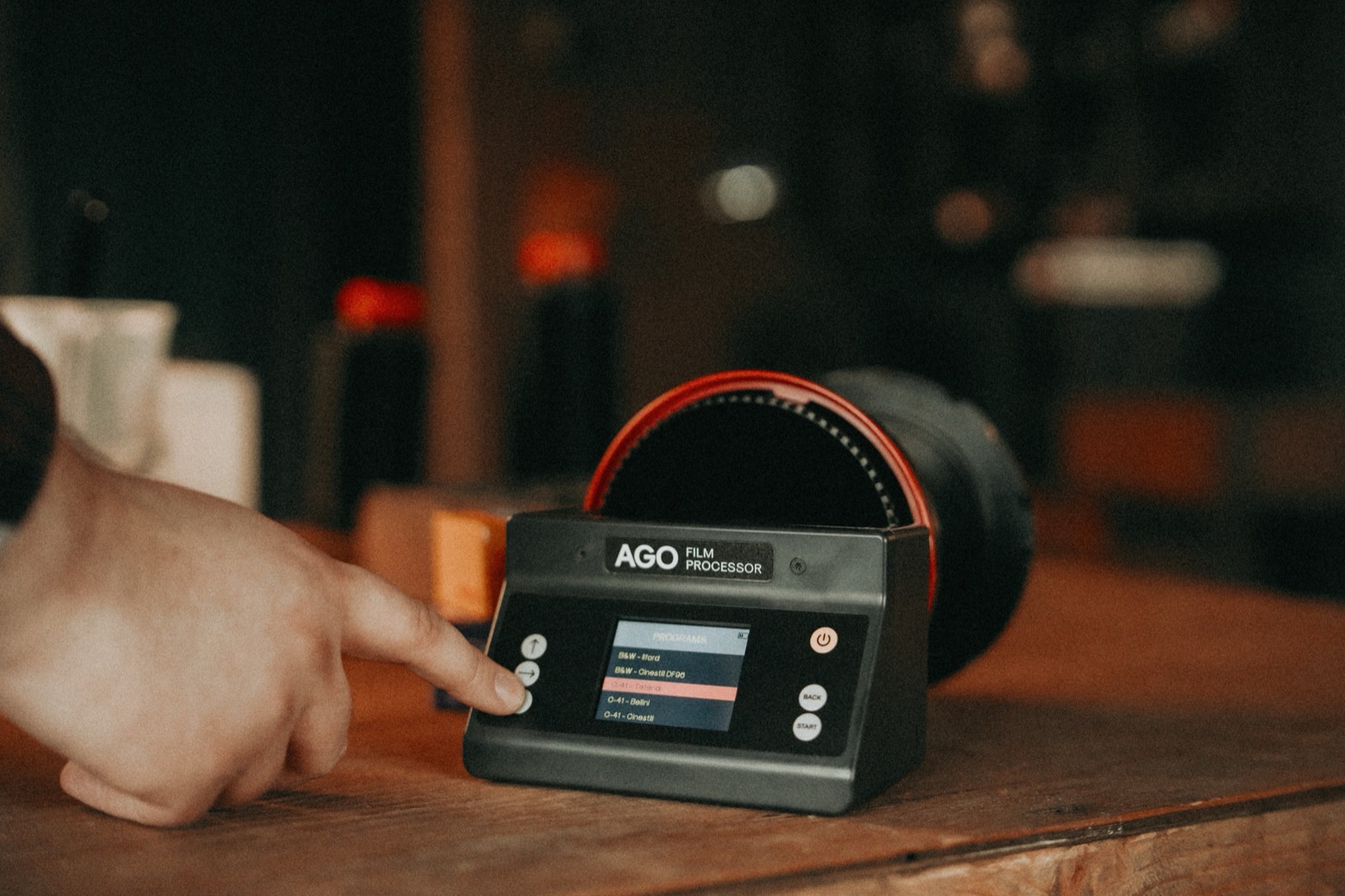
Developing in Japan has quietly got harder over the past decade. Minilabs have closed, and sending colour out costs more and takes longer than it used to. Going the other way — developing at home — has meant buying a temperature bath and a good thermometer, and paying tuition in ruined film.
That is the gap AGO closes. The most tedious part of the process, holding temperature, is absorbed by the machine as time. Between "send it to a lab" and "do everything yourself" there is now a third option: do it yourself, and let the machine keep the numbers honest.
We are stocking the AGO Film Processor (complete kit with a two-reel Paterson tank, and processor-only), the full range of Vintage Visual reels, pre-modified funnels, and the Paterson tanks and accessories that go with them.
Warranty and support
- 24-month warranty from the date of purchase from us.
- Support in Japanese and English — before you buy and after.
- Sales and shipping are for the Japanese market.
What happens next
Our first shipment is on order. The AGO Film Processor with tank, the processor on its own, the reels and the Paterson tanks all have live product pages ahead of arrival — get in touch if you want help choosing a configuration. We will announce arrival here and on Instagram.
If you have wanted to develop your own film but never had a darkroom to do it in, this is the machine to look at.
Common questions
- How do you hold 38°C for C-41 development at home?
- What is the AGO Film Processor, and how can it work without controlling temperature?
- Does the AGO work with a Paterson tank I already own?
- How much chemistry does rotary processing actually save?
- Can the AGO handle 4×5, Super 8 and RA-4 prints?
The rest are collected on our FAQ page.
Sources — Specifications and figures in this article come from Vintage Visual OÜ's own product documentation, the AGO Film Processor product page and the AGO wiki machine overview. Body 88 × 136 × 170 mm, 556 g, IP56, powered by 2× 18650 Li-ion cells over USB-C 5V / 3A. Chemistry volumes are the manufacturer's published minimum-volume chart.