Free shipping in Japan above ¥15,000 / worldwide delivery by Japan Post

NNeo Analog LabFilm / Paper / Darkroom Supply
Catalog
Film WashiFilm
Back toFilm
FilmFilm Washi / WASH-FILM120-W-ISO-25

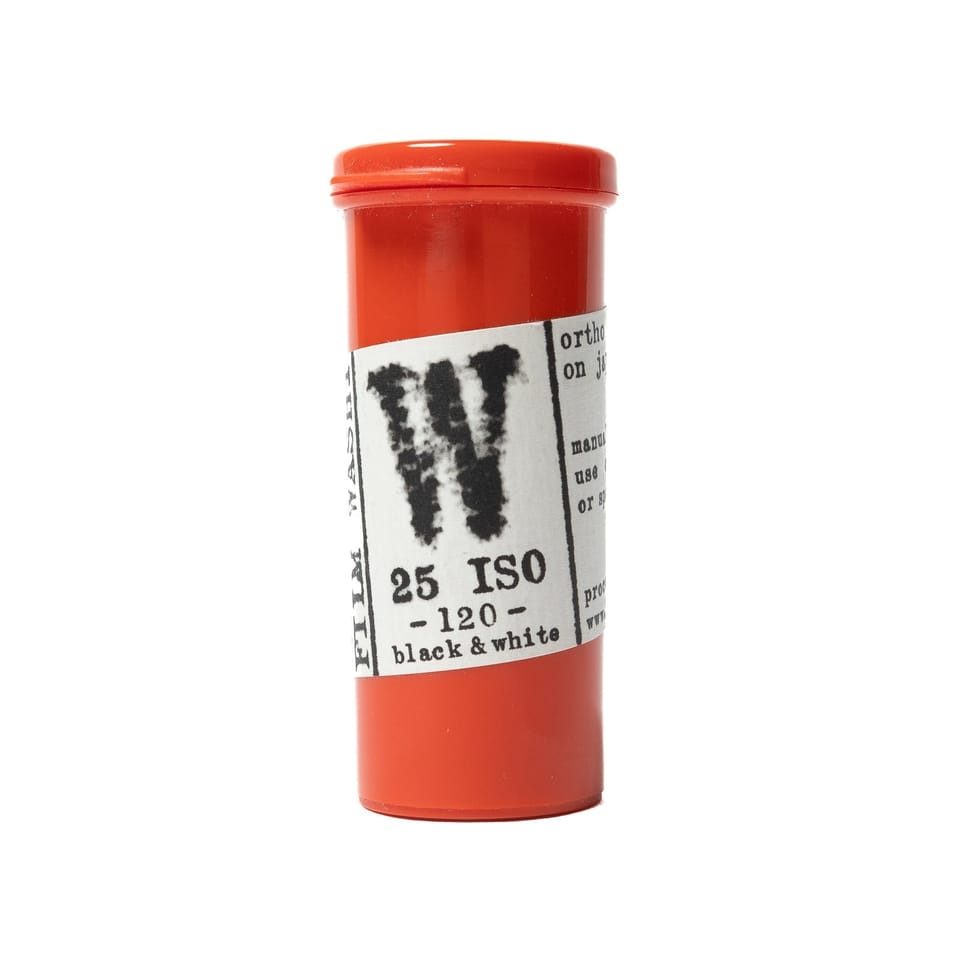
Film Washi "W" 120

120 / ISO 25 / orthochromatic, Kozo washi base

An orthochromatic ISO 25 black-and-white emulsion hand-coated onto 28 g/m² Kozo washi, so the paper's own fibres print through into every frame.

Unit price¥3,180(税込)+31 pt
On hand5 in stock
More inFilm
Product codeWASH-FILM120-W-ISO-25
Film format120
Film ISOISO 25
Film colorB&W
Film typeNegative
Format120 roll film

Overview

"W" is the film Film Washi was founded on: an orthochromatic black-and-white emulsion hand-coated, one roll at a time, onto Moriki Paper's Tosa Washi — a 28 g/m² Kozo paper — with an anti-curl layer behind it, in the company's workshop in Brittany. The datasheet rates both texture and contrast as very strong and transparency as medium, so the fibres of the sheet are part of every frame rather than a flaw, and Film Washi notes that coating each one by hand creates small variations or accidents that contribute to the product's graphic effect. Sensitivity peaks at 545 nm — high to blue, less to green, none to red — so the maker recommends it for urban, portrait and still-life work, and advises metering directly on the subject in portraits because orthochromatism can trick the meter. Nominal speed is 25 ISO, but Film Washi's own table brackets the working speed from 3 to 25 ISO depending on developer, and the datasheet warns the film does not have a large exposure latitude and is not very sensitive to artificial light; long exposures are no problem, while flash works only at full aperture, close range and set to the lowest sensitivity. The rolls are hand-spooled, so a few very delicate 120 transports can have trouble with them — never force the winding lever — and the exposed roll should be secured with a rubber band or tape as you unload it. Because the base is paper it cannot be loaded onto modern plastic developing reels: Film Washi specifies tray development in paper developer under a red 575 nm safelight — pre-wash in clear water, 2 to 3 minutes in developer, a plain water rinse with no acid stop bath, fixer until the remaining white emulsion has fully dissolved, then at least 15 minutes in cold clear water with no direct stream on the film. An old Correx- or Souplinox-type stripe tank works, and so does Film Washi's own 120 Processing Leader, taped to the head of the film so both can be wound onto a conventional spiral — that leader is a separate item and is not included here. Film Washi lists "W" among the films that need special handling, so develop it yourself or check with your lab first; scanned by transparency it holds the most half-tones, while scanning it in opacity mode like a print raises contrast and shows a waffle texture.

Organized by format, speed, and process.

Sample gallery

Photographic samples from this film

Tone profile

Kozo washi base / hand coated, one roll at a time

Customer Rating

No reviews yet

Write a Review

After receiving your order, you can submit a review using the link in your shipment notification email.

Common questions

Questions about this product

Does film need to be refrigerated?

Store unexposed film in a cool, dark place away from heat and humidity. For storage beyond a few months, refrigeration below 10°C is recommended. Let film return to room temperature in its packaging for 2-3 hours before shooting to avoid condensation.

What is the difference between C-41, E-6, and black-and-white processing?

C-41 develops color negative film, E-6 develops reversal (slide) film, and black-and-white negative film uses dedicated B&W chemistry. The Neo Analog Lab mail-in processing service handles C-41, E-6, ECN-2, and black-and-white.